



- EAER>
- Journal Archive>
- Contents>
- articleView
Contents
Citation
| No | Title |
|---|
Article View
East Asian Economic Review Vol. 29, No. 2, 2025. pp. 243-267.
DOI https://dx.doi.org/10.11644/KIEP.EAER.2025.29.2.449
Number of citation : 0View
156
Download
103



Uncertainty, Deep Regional Trade Agreements, and Global Value Chain Trade
|
|
Kongju National University |
|---|


Abstract
This study explores the role of regional trade agreements (RTAs) in mitigating the negative effects of uncertainty on trade, focusing on their depth and differential impacts on global value chain (GVC) and traditional trade. By employing an augmented gravity model with data from 70 countries spanning 1995 to 2020, the analysis reveals that deep RTAs, incorporating WTO-plus and WTO-extra provisions beyond tariff reductions, significantly alleviate the negative effects of uncertainty on both GVC and traditional exports. In contrast, shallow RTAs do not provide such mitigation. This study further highlights the resilience of GVC trade to uncertainty, driven by relationship-specific investments and long-term partnerships, while also recognizing its vulnerability to cumulative trade costs. Deep RTAs demonstrate more pronounced and persistent uncertainty-mitigation effects for GVC trade compared to traditional trade. Furthermore, we also find that WTO-extra provisions exert a more pronounced impact on both GVC and traditional exports. These findings underscore the critical importance of deep RTAs in fostering economic resilience and sustaining global supply chains amidst increasing global uncertainties, offering valuable policy implications for the design of trade agreements.
JEL Classification: F13, F14, F15
Keywords
Uncertainty, Deep Regional Trade Agreements, Global Value Chain Trade
I. Introduction
In the rapidly evolving global trade environment, uncertainties arising from economic fluctuations, policy shifts, and geopolitical tensions have significant implications for trade dynamics. The COVID-19 outbreak highlighted how shocks or uncertainties arising in one country or region can rapidly spread across a highly interconnected global economy. This is particularly critical within the framework of global value chains (GVCs), where production processes are geographically fragmented and heavily reliant on foreign intermediate inputs. Uncertainty in a sourcing nation can lead to significant supply chain disruption or even collapse. These challenges underscore the need for effective policies to ensure trade continuity and supply chain stability.
Regional Trade Agreements (RTAs) can serve as critical instruments for reducing these uncertainties, fostering trade integration, and enhancing economic stability. However, the role of RTAs in addressing trade-related uncertainty is far from homogenous, varying substantially based on their institutional depth and scope. This paper examines the distinct roles of shallow and deep RTAs in alleviating the negative impact of uncertainty on both GVC trade and traditional trade.
Theoretical frameworks have long emphasized the stabilizing role of trade agreements by reducing policy uncertainty and creating a predictable trade environment. For instance, Handley and Limão (2015) highlighted how trade agreements serve as credible commitments, reducing trade-policy uncertainty and fostering stable trading relationships. Similarly, Carballo et al. (2022) provide empirical evidence demonstrating the effectiveness of U.S. RTAs in alleviating the adverse effects of economic crises and uncertainties on trade flows, particularly during high-volatility periods such as the 2008 global financial crisis.1
Despite these insights, existing literature often treats RTAs as homogeneous entities, overlooking the heterogeneity between shallow and deep agreements. While shallow RTAs primarily focus on tariff reductions, deep RTAs encompass a broader array of provisions, including WTO-plus and WTO-extra elements such as regulatory harmonization, intellectual property rights protections, and competition policies (Hofmann et al., 2017). These provisions not only lower transaction costs but also provide a more robust institutional framework fostering predictability and stability in trade relationships. Consequently, deep RTAs are particularly instrumental in strengthening trade resilience, notably in GVC trade, which relies heavily on relationship-specific investments and long-term contractual commitments (Antràs, 2020; Gereffi et al., 2005).
The distinctive characteristics of GVCs—such as relationship-specific investments, long-term partnerships, and high switching costs—can lead to a reluctance to sever connections during periods of uncertainty. However, GVC trade is more sensitive to trade costs than traditional trade because these costs accumulate along production chains (Yi, 2003). As a result, the configuration of GVCs is strongly influenced by trade costs between countries responsible for different stages of production (Antràs, 2020). While the “stickiness” of GVC trade provides a stabilizing effect, its heightened sensitivity to trade costs makes it more susceptible than traditional trade. Consequently, the overall influence of uncertainty on GVC trade, relative to traditional trade, depends on the interplay between these stabilizing and cost-amplifying effects.
GVC participation often requires investment in relationship-specific assets, which are vulnerable to value loss outside of the specific relationship. Therefore, a more stable and predictable institutional environment is necessary to support such investments. In this regard, deep RTAs are relatively better suited than shallow RTAs, as they offer a broader and more stable institutional framework. Furthermore, because GVCs are highly sensitive to trade costs, deep RTAs—by encompassing cooperation across a wider range of areas—help mitigate potential increases in trade costs arising from unexpected sources of uncertainty more effectively than shallow RTAs.
Building upon these theoretical and empirical insights, this study investigates the extent to which the depth of RTAs affects their capacity to mitigate uncertainty in both GVC and traditional trade. By disaggregating trade flows into these two components, the analysis provides a detailed examination of the stabilizing effects of shallow and deep RTAs. To achieve this, an augmented gravity model is employed, utilizing panel data from 70 countries spanning the period 1995 to 2020. We incorporate a comprehensive set of fixed effects—country-pair, exporter-year, and importer-year fixed effects—to address potential endogeneity concerns and ensure robust estimation.
Our findings reveal that deep RTAs effectively mitigate the adverse effects of domestic uncertainty on both traditional and GVC exports, whereas shallow RTAs fail to provide similar mitigation effects. Notably, the role of deep RTAs in reducing the negative effects of uncertainty is more pronounced for GVC trade than for traditional trade. Moreover, the uncertainty-mitigation effects of deep RTAs on GVC trade exhibit greater persistence over time compared to their effects on traditional trade.
This analysis highlights the importance of distinguishing between RTA types when assessing their role in stabilizing trade flows under uncertainty. By examining the mitigation effects of RTAs across varying depths—from shallow to deep—this study provides empirical evidence on how RTA depth influences resilience to economic uncertainty. Ultimately, we contribute to the growing literature on trade agreements by offering a nuanced perspective on the heterogeneity of RTAs and their capacities to mitigate uncertainty. By bridging the gap between theoretical benefits and practical impacts, we aim to enrich academic and policy discussions on the role of trade agreements in a volatile global economy.
The remainder of this paper is structured as follows: Section II outlines the hypotheses regarding the role of RTAs in mitigating uncertainty and their heterogeneous effects on GVC and traditional trade. Section III details the empirical specification and the data used in the analysis. The estimation results are presented in Section IV. Finally, Section V offers a summary of the findings and concludes the paper.
1)While some studies investigate the impact of uncertainty on trade
II. Hypotheses on the Differential Role of Shallow and Deep RTAs in Mitigating Uncertainty and Their Heterogeneous Impact on GVC and Traditional Trade
In this section, we outline hypotheses concerning the differing institutional frameworks of shallow and deep RTAs and their respective impacts on GVC and traditional trade. First, we explore how shallow and deep RTAs play distinct roles in mitigating the adverse effects of uncertainty on trade. Second, we examine whether the mitigation effects of RTAs vary depending on the type of trade, specifically GVC vs. traditional trade.
1. Shallow RTAs vs. Deep RTAs
Numerous studies propose theoretical frameworks in which trade agreements help regulate policy uncertainty through commitments and credibility, fostering a stable trading environment (Handley, 2014; Handley and Limão, 2015, 2017; Limão and Maggi, 2015). Indeed, many trade agreements, including the EU and others, explicitly emphasize the goal of creating a stable, predictable, and transparent trade environment. Empirical studies also show that RTAs can mitigate the negative impacts of economic crises on trade flows, maintaining trade levels more effectively than non-member countries. For instance, Carballo et al. (2022) identify the role of RTAs in mitigating the effects of demand uncertainty on U.S. firm export dynamics during the 2008Q4?2009Q4 period. Similarly, Zhou et al. (2022) present that the establishment of the China?ASEAN Free Trade Area significantly reduced regional trade policy uncertainty, enhancing the productivity of Chinese export enterprises.
However, these studies implicitly treat trade agreements, particularly RTAs, as homogeneous, overlooking their inherent heterogeneity. Some RTAs comply with Article XXIV of the GATT by eliminating tariffs and other trade barriers across substantially all trade between member countries. Others, notified under the WTO’s Enabling Clause, feature more limited reductions in trade barriers. Additionally, deep RTAs extend beyond traditional provisions by including WTO-plus and WTO-extra elements, such as rules on investment, competition policy, and intellectual property rights, thereby fostering deeper economic integration. These provisions not only address tariffs and trade barriers but also broader regulatory and policy areas, reducing transaction costs, enhancing investor confidence, and mitigating growth volatility (Choi, 2019; Kpodar and Imam, 2016).
In contrast, shallow RTAs focus narrowly on tariff reductions with limited scope and may offer weaker mechanisms for mitigating uncertainty, especially during periods of economic volatility or shocks. Such agreements often lack the institutional depth needed to address challenges stemming from political uncertainty, economic policy instability, or financial crises. As a result, RTAs differ significantly in their level of trade liberalization, scope of coverage, and legal enforceability. Consequently, the impact of economic uncertainty on trade among member countries is also heterogeneous.
Building on the premise that deep RTAs—those incorporating WTO-plus and WTO-extra provisions—provide a more robust institutional framework fostering predictability and stability in trade relationships (Magi and Ossa, 2021; Mattoo et al., 2022), this study investigates how the depth of RTAs influences their ability to buffer trade against economic uncertainty. Specifically, we hypothesize that deep RTAs play a critical role in mitigating the negative effects of uncertainty on trade.
2. GVC Trade vs. Traditional Trade
GVC trade refers to the value of goods and services exported by a sector or country that crosses multiple borders, while traditional trade encompasses the value of goods and services crossing a single border (Borin et al., 2021). These two types of trade fundamentally differ in their nature and characteristics. GVCs often require relationship-specific investments, which are assets that hold little to no value outside of the partnership context (Gereffi et al., 2005). These investments, combined with long-term contracts and established partnerships, foster stable inter-firm relationships. As a result, firms engaged in GVCs face high switching costs when changing suppliers or buyers, making them hesitant to sever connections even during periods of economic or political uncertainty (Antràs, 2020). Moreover, connecting buyers and suppliers within GVCs, however, is not frictionless. The fixed costs of exporting and importing—including the costs of identifying and establishing suitable partnerships—are often sunk costs, which inherently lead to “stickiness” in GVC relationships (World Bank, 2020). These sunk costs create a reluctance to switch trading partners, as the perceived risks and costs of switching frequently outweigh potential benefits. This inherent stability in GVCs acts as a buffer against network disruptions, ensuring supply chain resilience.
Additionally, GVCs are characterized by fragmented production stages across borders, leading to final goods accumulating trade costs at each stage of production. Yi (2003) highlights that these cumulative trade costs create a nonlinear impact on trade, amplifying their effects for downstream production stages. Koopman et al. (2014) and Diakantoni et al. (2017) further emphasize that production stages contributing relatively little value are disproportionately affected by these costs. This accumulation of trade costs makes GVC trade more sensitive to such costs compared to traditional trade. As Antràs (2020) notes, the configuration of GVCs heavily depends on trade costs between countries involved in different stages of production. Higher trade costs not only increase the prices of exported goods, as seen in traditional trade, but also raise the costs of imported inputs used within GVCs. Consequently, GVC trade is more likely to occur between countries with lower levels of uncertainty, as the trade costs arising from uncertainty tend to accumulate across production stages.
These unique features of GVCs—relationship-specific investments, long-term partnerships, and high switching costs—render GVC trade more resilient to external changes, such as uncertainty or economic shocks. However, the same trade costs that contribute to stability also make GVC trade more vulnerable to uncertainty when trade costs between countries are high. This creates a dual effect: while GVC trade remains stable due to its “sticky” nature, it is also more sensitive to trade costs compared to traditional trade. Thus, the overall impact of uncertainty on GVC trade relative to traditional trade depends on the balance between these stabilizing and cost-amplifying effects.
Moreover, deep RTAs contribute to reducing regulatory heterogeneity and improving policy predictability by incorporating WTO-plus and WTO-extra provisions such as regulatory policies, intellectual property rights protections, and investment policies through legally enforceable provisions. These institutional frameworks reduce uncertainty and encourage firms to engage in GVC activities (Antràs and Staiger, 2012; Ruta, 2017). In contrast, shallow RTAs, which focus primarily on tariff reductions, offer limited benefits for GVC trade due to its sensitivity to cumulative trade costs, as they fail to address non-tariff barriers, regulatory misalignments, and policy uncertainties that can disrupt cross-border production networks and increase operational risks for firms. Therefore, deep RTAs play a more significant role in mitigating the negative effects of uncertainty for GVC trade compared to traditional trade.
Building on these discussions, we analyze how uncertainty influences GVC and traditional trade. Specifically, we explore whether deep RTAs play a more significant role in mitigating the adverse effects of uncertainty on GVC trade compared to traditional trade, as deep RTAs can reduce cumulative trade costs and enhance supply chain stability. This study empirically examines how RTAs of varying depth mitigate uncertainty, focusing on their differential impacts on GVC and traditional trade, and highlights the heterogeneous effects of deep and shallow RTAs.
III. Empirical Specification and Data
1. Empirical Specification
We begin by estimating the trade creation effects of both shallow and deep RTAs using an augmented gravity model, a widely used in the literature for assessing the impact of RTAs on trade flows (Head and Mayer, 2014). To account for the depth of agreements, we incorporate a variable (
When estimating a gravity equation, a key challenge is the potential endogeneity of our primary variables of interest—shallow and deep RTAs. Controlling for both bilateral and multilateral trade resistance is critical (Anderson and van Wincoop, 2003). Neglecting the multilateral resistance terms can result in biased estimates of the variables of interest (Baldwin and Taglioni, 2006). To address the issue of endogeneity, we employ a series of fixed effects. Specifically, we introduce country-pair fixed effects following Baier and Bergstrand (2007), which account for all time-invariant bilateral trade costs and unobservable country-pair characteristics (Egger and Nigai, 2015). Additionally, we include importer-year and exporter-year fixed effects to control for country-specific shocks over time and the multilateral resistance terms (Olivero and Yotov, 2012). These fixed effects effectively absorb the economic size variables such as the GDPs of the exporter and importer, as well as other time-varying observable and unobservable characteristics of the exporters and importers.2
Building on these considerations, the baseline empirical specification is as follows:

where the dependent variable
The terms
This study explores whether RTAs mitigate the negative impact of uncertainty on trade. Specifically, we investigate which type of RTAs—shallow or deep—effectively shield trade from uncertainty. Do shallow RTAs provide such protection, or are deep RTAs uniquely critical in alleviating the adverse effects of uncertainty? To analyze the role of RTAs in this context, we include interaction terms between RTAs and uncertainty in the empirical model. The estimation equation is thus specified as follows:

where
2. Data
We use the World Uncertainty Index (WUI) as a proxy for a country’s uncertainty level. This index quantifies uncertainty by counting the frequency of specific “uncertainty-related” keywords in the Economic Intelligence Unit (EIU) country reports. Baker et al. (2013) initially developed a similar measure, the Economic Policy Uncertainty Index, for the United States. They used a text-mining approach to track the frequency of uncertainty-related words in the top 10 U.S. newspapers from 1985 onward, later extending it to 11 countries. While valuable, this index is primarily limited to developed countries.
More recently, Ahir et al. (2022) constructed the World Uncertainty Index for an unbalanced panel of 143 countries. Instead of relying on U.S. newspapers, they calculate the frequency of uncertainty-related words in EIU country reports and measure the index as the ratio of uncertainty-related words to the total word count in these reports. This approach enhances the comparability of the WUI across countries and minimizes variations arising from different data sources. As a result, the WUI offers much broader coverage of countries and time periods, making it a more comprehensive measure for quantifying uncertainty. Furthermore, the WUI reflects broader economic uncertainty, influencing overall economic performance—such as production, investment, employment, and trade—rather than uncertainty specific to trade.
To construct deep RTAs representing the depth of RTAs, we utilize Deep Trade Agreement database 1.0 (horizontal depth) provided by Hofmann et al. (2017).
Data on GVC and traditional trade are sourced from Borin et al. (2021), who decompose total trade into these two categories using the Inter-Country Input-Output Table from the OECD. This dataset covers 76 countries over the period 1995-2020.
Table 1 presents the summary statistics for the variables used in this study. As exporters and importers are symmetric, the uncertainty index statistics for the origin and destination countries are identical. Consequently, we do not separately report the interaction terms between shallow RTAs and the uncertainty index for the destination country, or between deep RTAs and the uncertainty index for the destination country. Additionally, since the WUI does not include data for six countries—Brunei Darussalam, Cyprus, Estonia, Iceland, Luxembourg, and Malta—listed in the OECD’s ICIO dataset, our final dataset is limited to 70 countries.3 Among the total observations, 57,026 observations (approximately 38.5%) correspond to shallow RTAs (where the shallow RTA dummy equals one), and 50,460 observations (approximately 34%) correspond to deep RTAs.
3. Exploratory Data Analysis
Before turning to the structural estimations, we examine the raw data for evidence indicating which types of RTAs help mitigate the adverse impacts of uncertainty on trade dynamics. In order to facilitate this analysis, countries are divided into two groups: RTA member and non-member countries. The trade volume and the level of uncertainty for each group are quantitatively assessed using the simple arithmetic mean. We examine the relationship between the first differences of these variables to remove the influence of time.
Figure 1 illustrates the relationship between changes in uncertainty and variations in the simple average of total exports for both RTA member and non-member countries. The left graph focuses on shallow RTA members and non-members, while the right graph highlights the same relationship for deep RTA members and non-members.
In the left graph, an increase in uncertainty correlates with a decline in the average total exports for both shallow RTA member and non-member countries. Notably, the contraction in exports is more pronounced for non-member countries compared to member countries.
The right graph similarly shows that rising uncertainty is associated with reductions in total exports. However, a distinct difference emerges: the impact of increased uncertainty on the trade of deep RTA member countries is significantly smaller than on that of shallow RTA member countries. The results of a simple regression analysis, as detailed in Appendix Table 2 and 3, reveal that the coefficients of uncertainty for non-member countries in both shallow and deep RTAs are negative and statistically significant at the 1% level. Additionally, while the coefficient of uncertainty for shallow RTA member countries is also negative and statistically significant at the 5% level, its magnitude is smaller compared to that of non-member countries. In contrast, these coefficients for member countries in deep RTAs are not statistically significant.
Figure 2 elucidates how GVC exports from RTA member and non-member countries respond to fluctuations in uncertainty. Analogous to total exports, the GVC exports of both RTA members and non-member countries exhibit a decline in the face of increasing uncertainty, with the GVC exports of non-member countries demonstrating a heightened sensitivity relative to those of RTA member countries. Moreover, the right graph demonstrates that the GVC exports of deep RTA members exhibit significantly lower sensitivity to uncertainty compared to those of shallow RTA members. This trend is consistent with the patterns observed in traditional exports, as shown in Figure 3.
These simple analyses show that the negative effect of uncertainty on exports is less pronounced for shallow RTA member countries compared to non-member countries. Moreover, exports of deep RTA member countries demonstrate an even lower sensitivity to uncertainty than those of shallow RTA member countries. Although this preliminary analysis offers insights into the relationships between RTAs and different types of trade, it is crucial to recognize that the results are derived from simple averages and do not consider essential control variables that may affect GVC and traditional trade. Consequently, these findings should be interpreted with caution. To reach definitive conclusions about the impact of both deep and shallow RTAs on GVC and traditional trade, a more robust econometric analysis incorporating relevant control variables is necessary.
2)Another key estimation issue involves handling zero trade flows. The Ordinary Least Squares (OLS) estimator has a notable limitation: it excludes zero trade flows because the logarithmic transformation of trade values requires strictly positive observations. This results in the loss of valuable information. To address this,
3)Appendix
IV. Results
1. Trade Creation Effects of Deep RTAs
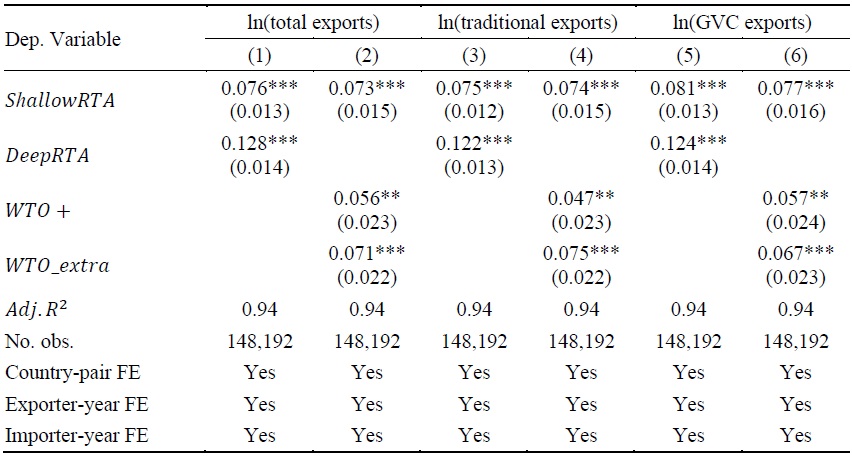
The estimation results regarding the trade creation effects of both shallow and deep RTAs are delineated in Table 2. All estimations are obtained from the application of three-way fixed effects, encompassing exporter-year, importer-year, and country-pair fixed effects. The initial two columns elucidate the influence of shallow and deep RTAs on aggregate exports, the subsequent two columns present the estimation results pertaining to their impact on traditional exports, while the final two columns report the effects of RTAs on GVC exports. Moreover, deep RTAs are categorized into WTO plus and WTO extra, with their respective impacts on total exports, traditional exports, and GVC exports presented in columns (2), (4), and (6).
In columns (1)-(6), the coefficients associated with both shallow and deep RTAs exhibit positive values and attain statistical significance at the 1% level. Additionally, the coefficients of deep RTAs in columns (1), (3), and (5) are positive and statistically significant, with their magnitudes surpassing those of shallow RTAs, thereby indicating that deep RTAs generate additional trade creation effects among member nations, which are greater than those associated with shallow RTAs. In columns (2), (4), and (6), the coefficients for WTO plus and WTO extra similarly demonstrate positive values and achieve statistical significance at a minimum of the 5% level, implying that both WTO plus and WTO extra facilitate enhanced trade among the member countries of deep RTAs.
While the most of studies focuses on the trade creation effects of deep RTAs on overall trade, we investigate the implications of deep RTAs on both GVC and traditional trade by systematically disaggregating total exports into GVC and traditional exports. Our findings reveal that deep RTAs confer additional trade creation benefits not only on total trade, but also on both traditional and GVC trade. In particular, we find that WTO-extra provisions have a significantly greater effect on both GVC and conventional exports.
2. The Impact of Uncertainty on Trade
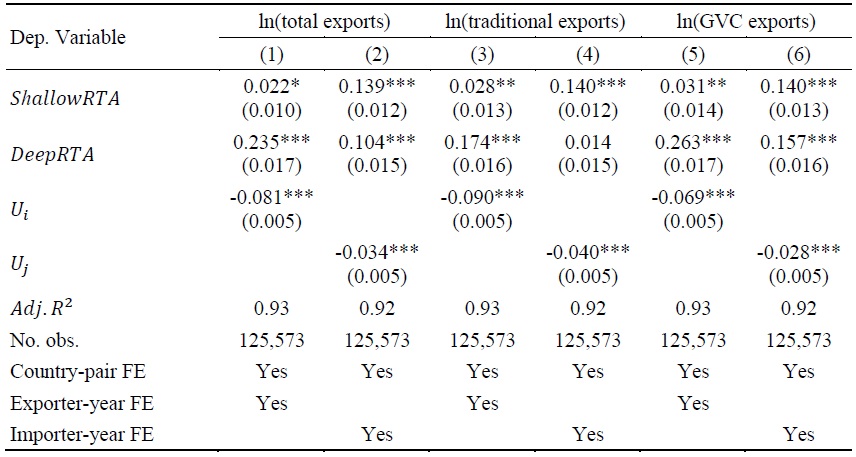
Table 3 reports the estimation results on the impact of uncertainty on trade. To estimate the effects of time-varying uncertainty originating from either the exporter or importer, it is imperative to note that including both exporter-year and importer-year fixed effects simultaneously is not feasible. This is because exporter-year (importer-year) fixed effects absorb the impact of domestic (importer) uncertainty on exports. By differentiating between uncertainty in exporting and importing countries, this approach enables an analysis of supply-side and demand-side uncertainty on trade while minimizing bias from omitted variables.4
In all columns, the coefficients for both shallow and deep RTAs are positive and statistically significant, except for deep RTAs in traditional exports, thereby reaffirming the robustness of our preceding findings. In columns (1), (3) and (5), the coefficients of exporter’s uncertainty (
Additionally, the coefficient of uncertainty in column (3) is -0.090, whereas in column (5) it is -0.069. These results mean that traditional exports are more sensitive to uncertainty compared to GVC exports. This is attributed to the distinct features of GVCs that requires relationship-specific investments, and are typically characterized by long-term contracts and established partnerships fostering strong, stable inter-firm relations (Gereffi et al., 2005; World Bank, 2020; Antràs, 2020). These inherent relationships provide a buffer against disruptions in GVCs, thereby ensuring stability in their supply chains, thereby GVC trade is less sensitive to uncertainty than traditional trade. Finally, the magnitudes of coefficients on domestic uncertainty are larger than those of foreign country’s uncertainty, suggesting that supply-side uncertainty exerts a more pronounced effect on exports compared to demand-side uncertainty.
3. Mitigating the Negative Impact of Uncertainty on Trade
The estimation results incorporating interaction terms between uncertainty and RTAs are presented in Table 4. Following Borin et al. (2021), GVC trade is further classified into backward GVC, forward GVC, and two-sided GVC. Forward GVC trade refers to exports of inputs that are re-exported by the trading partner, backward GVC trade involves the use of imported inputs in goods exported abroad, and two-sided GVC trade encompasses all imported inputs embedded in the re-exports of a bilateral partner, capturing both backward and forward GVC trade.
Uncertainty’s impact on GVC trade can vary depending on the form of participation: in forward participation—where value added is generated domestically—domestic uncertainty predominates, whereas in backward participation—where production relies on imported parts or intermediates—overseas uncertainty exerts greater influence. Moreover, since trade costs accumulate across production stages and amplify downstream (Yi, 2003), their effects differ between forward and backward participation. This heterogeneity aligns with Acemoglu et al. (2016), who show that supply- and demand-side shocks have asymmetric impacts on upstream versus downstream industries, and with Park and Park (2024), who find that input-linked uncertainty from sourcing foreign intermediates has a more pronounced negative effect than output-linked uncertainty.
In all estimates, the interaction terms between shallow RTAs and uncertainty are insignificant, while the coefficients for shallow RTAs themselves are significant. These findings suggest that while shallow RTAs enhance trade between member countries, they do not mitigate the effects of uncertainty. Conversely, the interaction terms between deep RTAs and domestic uncertainty are positive and statistically significant, at least at the 5% level, indicating that deep RTAs help mitigate the adverse effects of domestic uncertainty on both traditional and GVC exports. Because exporter-year fixed effects absorb the variation in exporter uncertainty, the coefficient for exporter uncertainty cannot be separately identified in the estimation. Nevertheless, as shown in Table 3, exporter uncertainty has a negative effect on trade. The positive coefficient on the interaction term between Deep RTA and uncertainty suggests that the negative impact of uncertainty on trade is attenuated in countries with deeper RTAs (i.e., positive values of Deep RTA), compared to those without such agreements (i.e., where Deep RTA equals zero).
Additionally, the interaction term between deep RTAs and destination country uncertainty is positive and significant at the 5% level in all estimates.5 This suggests that deep RTAs reduce the negative impact of partner uncertainty specifically on GVC trade. Notably, the mitigation effects of partner country uncertainty are more pronounced in forward and two-sided GVC trade, while the effects on backward GVC trade remain relatively limited.
4. Persistence of Mitigation Effects
The mitigation effects of deep RTAs vary over time and across different types of trade. To capture these dynamics, we estimate Eq. (2) using lagged RTA variables. These estimations also address potential issues such as reverse causality, simultaneity, and endogeneity.
Table 5 presents the estimation results on the lasting role of deep RTAs in mitigating the negative effects of uncertainty. Each lagged variable is estimated separately; however, for brevity, we present the results together in one column. The findings show that the uncertainty-mitigation effects of deep RTAs on traditional trade remain significant for up to 4 years. In comparison, these effects on GVC trade are more persistent. Specifically, the uncertainty-mitigation effects on GVC trade last for up to 11 years.
The findings suggest several important implications, particularly when considering the distinctive features of GVC trade, such as relationship-specific investments, long-term partnerships, and high switching costs. These characteristics make GVC trade inherently more resilient to external changes or uncertainty, as firms are less likely to easily sever long-term relationships or switch partners due to the significant investments and commitments involved. This resilience is enhanced by the role of deep RTAs, which help reduce regulatory heterogeneity and improve policy predictability.
By providing legally enforceable provisions across various areas, deep RTAs create a more stable and predictable environment for GVC trade. The persistence of uncertainty mitigation effects—lasting up to 11 years for GVC trade—indicates that deep RTAs contribute to long-term stability by establishing a secure and reliable regulatory framework for businesses.
In sum, the findings underscore the importance of deep RTAs in enhancing the resilience of GVC trade by reducing uncertainty and fostering long-term business relationships through regulatory cooperation and legal safeguards. These effects can help sustain global supply chains and improve economic stability, particularly in times of global uncertainty.
5. Summary and Conclusion
This study explores the role of RTAs, particularly their depth and heterogeneity, in mitigating trade-related uncertainties and their differential impact on GVC trade and traditional trade. Key findings of this study underline the significant distinction between shallow and deep RTAs in their capacity to enhance trade stability, especially under conditions of uncertainty.
While shallow RTAs primarily focus on tariff reductions and limited provisions, deep RTAs, with their incorporation of WTO-plus and WTO-extra elements, address broader regulatory and policy domains, thereby significantly enhancing trade predictability and stability. We find that deep RTAs yield greater trade creation effects and more effectively shield trade with member countries from uncertainty than shallow RTAs.
While the most of studies focuses on the trade creation effects of deep RTAs on overall trade, we investigate the implications of deep RTAs on both GVC and traditional trade by systematically disaggregating total exports into GVC and traditional exports. Our findings reveal that deep RTAs confer additional trade creation benefits not only on total trade, but also on both traditional and GVC trade.
The study also highlights the inherent features of GVC trade, driven by relationship-specific investments, long-term partnerships, and high switching costs. These characteristics buffer GVC trade against uncertainty. However, the cumulative trade costs associated with GVCs make them particularly sensitive to uncertainty. Thus, the overall impact of uncertainty on GVC trade relative to traditional trade depends on the balance between these stabilizing and cost-amplifying effects.
The empirical results show that deep RTAs help mitigate the adverse effects of domestic uncertainty on both traditional and GVC exports, while shallow RTAs do not mitigate the effects of uncertainty. We also find that the role of deep RTAs in mitigating the negative effects of uncertainty is more pronounced for GVC trade than for traditional trade. Additionally, the findings show that the uncertainty-mitigation effects of deep RTAs on GVC trade are more persistent than on traditional trade.
Unlike most research that focuses on the aggregate trade‐creation effects of deep RTAs, our study disaggregates total exports into GVC and traditional components. We find that deep RTAs not only bolster overall trade but also generate additional gains for both traditional and GVC exports. Notably, WTO-extra provisions exhibit a markedly stronger impact on each export category.
The findings of this study address the critical role of deep RTAs in fostering economic resilience and sustaining global supply chains amidst uncertainty. Policymakers are encouraged to prioritize the negotiation and implementation of deep RTAs that include legally enforceable provisions addressing behind-the-border measures, such as intellectual property rights, investment policies, and regulatory cooperation. Such agreements contribute to enhancing the stability of trade relationships, thereby mitigating the negative effects of uncertainty on trade.
In conclusion, the study contributes to the understanding of how trade agreements function as stabilizing mechanisms in a volatile global economy. By differentiating the effects of shallow and deep RTAs on trade dynamics and highlighting their unique roles in GVC and traditional trade, this study provides valuable insights for designing future trade policies that promote trade stability.
4)Countries differ not only in the form and intensity of their GVC participation but also in the nature and severity of the uncertainties they face. Consequently, exporter- and importer-side uncertainty affect trade heterogeneously. We therefore analyze these two channels of uncertainty separately.
5)Variance inflation factor (VIF) diagnostics show mean values ranging from 1.91 to 2.67, indicating no serious multicollinearity between the shallow and deep RTA variables.
Tables & Figures
Table 1.
Summary Statistics
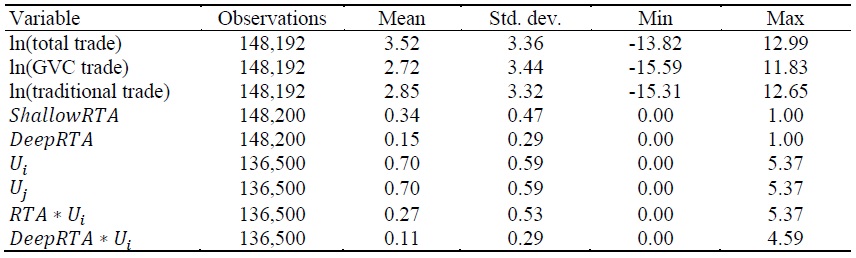
Figure 1.
Uncertainty and Total Exports for RTA Members and Non-members
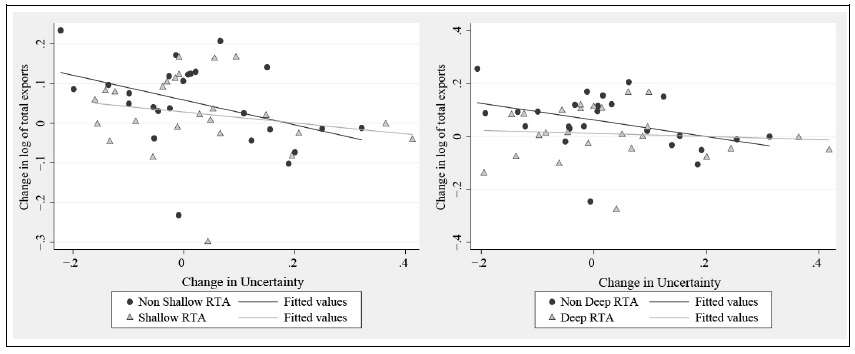
Table 2.
Trade Creation Effects of Deep RTAs
Notes: Robust standard errors are in parentheses. *, **, and *** indicate statistical significance at 10%, 5%, and 1% levels, respectively.
Table 3.
The Differential Impact of Uncertainty on Trade Types
Notes: Robust standard errors are in parentheses. *, **, and *** indicate statistical significance at 10%, 5%, and 1% levels, respectively.
Figure 2.
Uncertainty and GVC Exports for RTA Members and Non-members
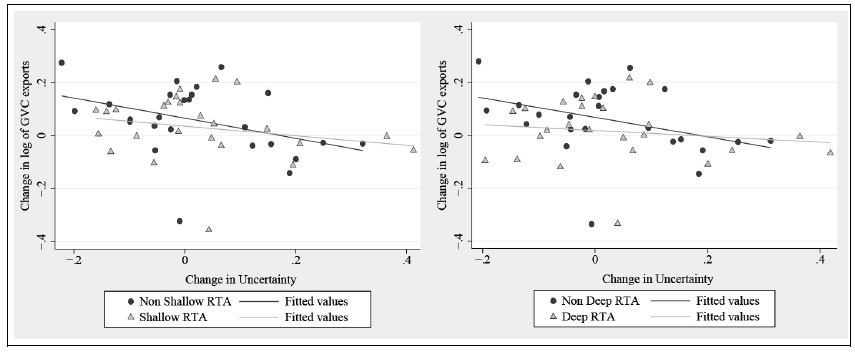
Figure 3.
Uncertainty and Traditional Exports for RTA Members and Non-members
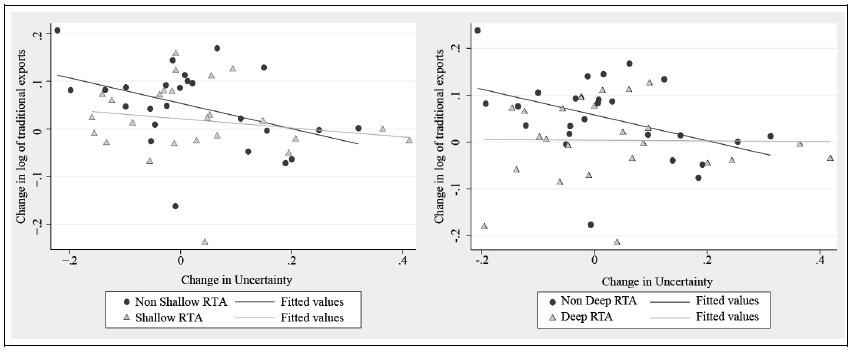
Table 4.
The Uncertainty Mitigation Effects of RTAs
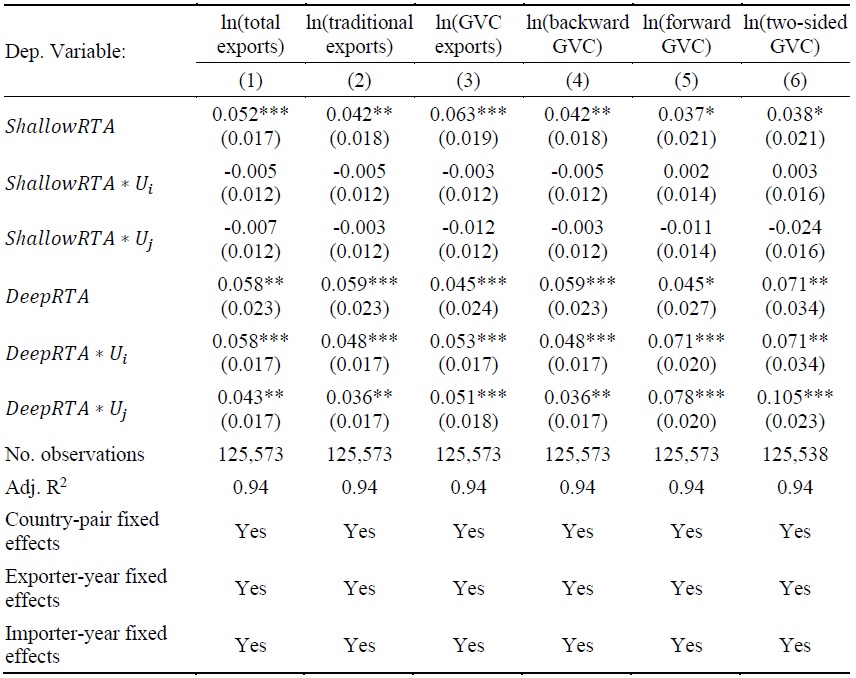
Notes: Robust standard errors are in parentheses. *, **, and *** indicate statistical significance at 10%, 5%, and 1% levels, respectively.
Table 5.
Persistence of Mitigation Effects of Deep RTAs
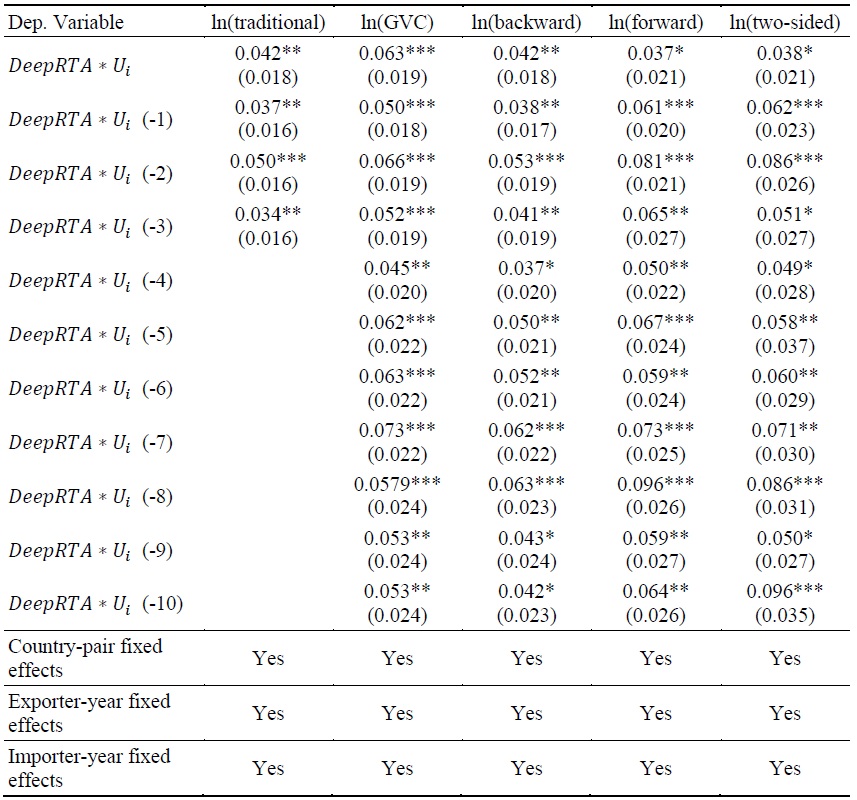
Notes: Robust standard errors are in parentheses. *, **, and *** indicate statistical significance at 10%, 5%, and 1% levels, respectively. The variables for shallow and deep RTAs are included in the estimation but are not reported.
Table A1.
The List of Countries
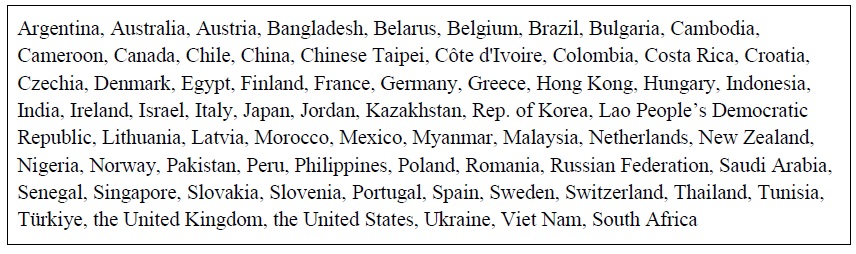
Table A2.
Changes in Shallow RTAs and Uncertainty
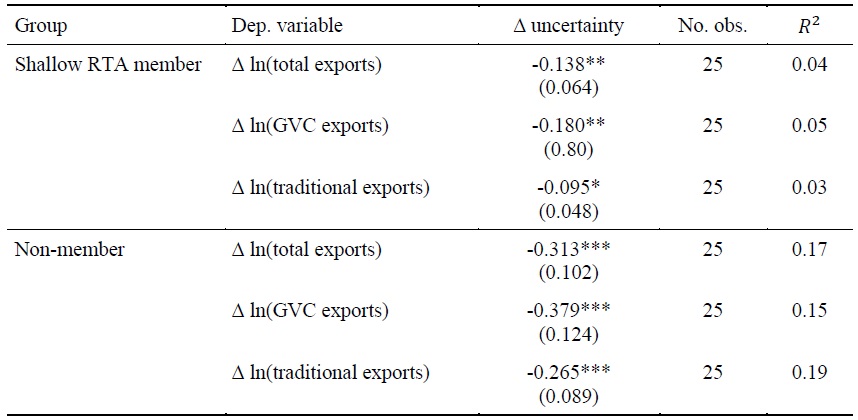
Notes: Robust standard errors are in parentheses. *, **, and *** indicate statistical significance at 10%, 5%, and 1% levels, respectively.
Table A3.
Changes in Deep RTAs and Uncertainty
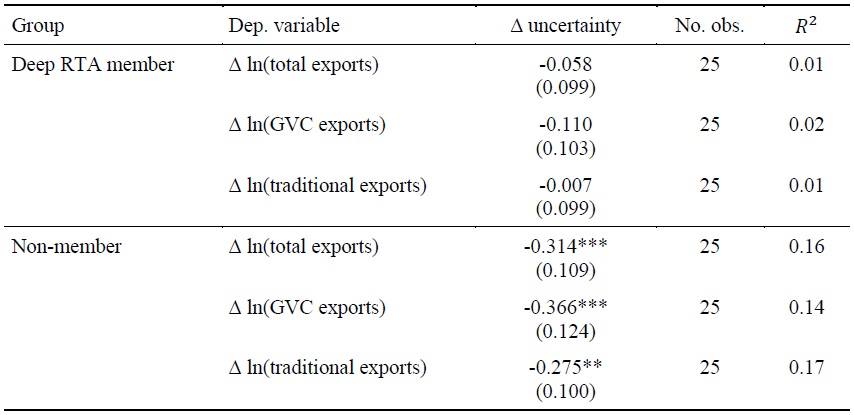
Notes: Robust standard errors are in parentheses. *, **, and *** indicate statistical significance at 10%, 5%, and 1% levels, respectively.
References
-
Acemoglu, D., Akcigit, U., and W. Kerr. 2016. “Networks and the Macroeconomy: An Empirical Exploration.” In Eichenbaum, M and J.A. Paker. (eds.)
NBER Macroeconomics Annual 2015 , vol. 30. University of Chicago Press. -
Ahir, H., Bloom, N., and D. Furceri. 2022. “The World Uncertainty Index.” NBER Working Paper No. 29763.
https://doi.org/10.3386/w29763 -
Anderson, J. E. and E. van Wincoop. 2003. “Gravity with Gravitas: A Solution to the Border Puzzle.”
American Economic Review , vol. 93, no. 1, pp. 170-192.
-
Antràs, P. 2020. “Conceptual aspects of global value chains.”
World Bank Economic Review , vol. 34, no. 3, pp. 551-574.
-
Antràs, P. and R. W. Staiger. 2012. “Trade Agreements and the Nature of Price Determination.”
American Economic Review Papers and Proceedings , vol. 102, no. 3, pp. 470-476.
-
Baier, S. L. and J. H. Bergstrand. 2007. “Do free trade agreements actually increase members’ international trade?”
Journal of International Economics , vol. 71, no. 1, pp. 72-95.
- Baldwin, E. and D. Taglioni. 2006. “Gravity for Dummies and Dummies for Gravity Equations.” NBER Working Paper, no. 12516.
-
Baker, S. R., Bloom, N., and S. J. Davis. 2016. “Measuring economic policy uncertainty.”
The Quarterly Journal of Economics , vol. 131, no. 4, pp. 1593-1636.
- Borin, A., M. Mancini, and D. Taglioni. 2021. “Economic Consequences of Trade and Global Value Chain Integration: A Measurement Perspective.” World Bank Policy Research Working Paper, no. 9785.
-
Carballo, J., Handley, K., and N. Limão. 2022. “Economic and policy uncertainty: Aggregate export dynamics and the value of agreements.”
Journal of International Economics , vol. 139, 103661.
- Choi, N. 2019. “Deeper Regional Integration and Global Value Chains.” KIEP Working Paper, no. 19-02. Korea Institute for International Economic Policy.
- Constantinescu, C., A. Mattoo, and Ruta., M. 2019. “Policy Uncertainty, Trade, and Global Value Chains.” World Bank Policy Research Working Paper, no. 9048.
- Diakantoni, A., Escaith, H., Roberts, M., and T. Verbeet. 2017. “Accumulating Trade Costs and Competitiveness in Global Value Chains.” World Trade Organization (WTO) Working Paper Economic Research and Statistics Division (ERSD) 2017-2, WTO, Geneva.
-
Egger, P. and S. Nigai. 2015. “Structural Gravity with Dummies Only: Constrained ANOVA-Type Estimation of Gravity Models.”
Journal of International Economics , vol. 97, no. 1, pp. 86-99.
-
Eum, J. 2023. “Non-tariff measures along global value chains: evidence from ASEAN countries.”
Asian Pacific Economic Literature , vol.37, no. 2, pp. 27-53.
-
Gereffi, G., Humphrey, J., and T. Sturgeon. 2005. “The Governance of Global Value Chains.”
Review of International Political Economy , vol. 12, no. 1, pp. 78-104.
-
Handley, K. 2014. “Exporting under Trade Policy Uncertainty: Theory and Evidence.”
Journal of International Economics , vol. 94, no. 1, pp. 50-66.
-
Handley, K. and N. Limão. 2015. “Trade and Investment under Policy Uncertainty: Theory and Firm Evidence.”
American Economic Journal: Economic Policy , vol. 7, no. 4, pp. 189-222.
-
Handley, K. and N. Limão. 2017. “Policy Uncertainty, Trade, and Welfare: Theory and Evidence for China and the United States.”
American Economic Review , vol. 107, no. 9, pp. 2731-2783.
-
Head, K. and T. Mayer. 2014. “Gravity Equations: Workhorse, Toolkit, and Cookbook.” In Gopinath, G., Helpman, E., and K. Rogoff. (eds.)
Handbook of International Economics , vol. 4, pp. 131-195. Elsevier. - Hofmann, C., Osnago, A., and M. Ruta. 2017. “Horizontal Depth: A New Database on the Content of Preferential Trade Agreements.” Policy Research Working Paper No. 7981. Washington, DC: World Bank Group.
-
Koopman, R., Wang, Z., and Shang-Jin Wei. 2014. “Tracing Value-Added and Double Counting in Gross Exports.”
American Economic Review , vol. 104, no. 2, pp. 459-494.
-
Korwatanasakul, U. and Y. Baek. 2020. “The Effect of Non-Tariff Measures on Global Value Chain Participation.”
Global Economic Review , vol. 50, no. 3, pp. 193-212.
-
Kpodar, K. and P. Imam. 2016. “Does a Regional Trade Agreement Lessen or Worsen Growth Volatility? An Empirical Investigation.”
Review of International Economics , vol. 24, no. 5, pp. 949-979.
-
Limão, N. and G. Maggi. 2015. “Uncertainty and Trade Agreements.”
American Economic Journal: Microeconomics , vol. 7, no. 1, pp. 1-42.
-
Maggi, G. and R. Ossa. 2021. “The Political Economy of Deep Integration.”
Annual Review of Economics , vol. 13, pp. 19-38.
-
Mattoo, A., Mulabdic, A., and M. Ruta. 2022. “Trade Creation and Trade Diversion in Deep Agreements.”
Canadian Journal of Economics , vol. 55, no.3, pp. 1598-1637.
- Nana, I., Ouedraogo, R., and S. J. Tapsoba. 2024. “The Heterogeneous Effects of Uncertainty on Trade.” IMF Working Paper, no. 24-139.
-
Olivero, M. P. and Y. V. Yotov. 2012. “Dynamic Gravity: Endogenous Country Size and Asset Accumulation.”
Canadian Journal of Economics , vol. 45, no. 1, pp. 64-92.
-
Park, S. and I. Park. 2024. “The spillover effect of global uncertainty through input–output linkage.”
The World Economy , vol. 48, no. 2, pp. 373-401.
-
Raimondi, V., Piriu, A., Swinnen, J., and A. Olper. 2023. “Impact of global value chains on tariffs and non-tariff measures in agriculture and food.”
Food Policy , vol. 118, 102469.
- Ruta, M. 2017. “Preferential Trade Agreements and Global Value Chains: Theory, Evidence, and Open Questions.” Policy Research Working Paper, no. 8190. World Bank.
-
Santos Silva, J. M. C. and S. Tenreyro. 2006. “The Log of Gravity.”
The Review of Economics and Statistics , vol. 88, no.4, pp. 641-658.
- Wang, Z., Wei, S., Yu, X., and K. Zhu. 2017. “Measures of Participation in Global Value Chain and Global Business Cycles.” NBER Working Paper, no. 23222.
-
World Bank. 2020.
World Development Report: Trading for Development in the Age of Global Value Chains . Washington, DC: World Bank Publications. -
Yi, Kei-Mu. 2003. “Can Vertical Specialization Explain the Growth of World Trade?”
Journal of Political Economy , vol. 111, no. 1, pp. 52-102.
-
Zhou, K., Yu, L., Jiang, X., and S. Kumar. 2022. “The Impact of Regional Trade Policy Uncertainty on the Productivity of Chinese Export Enterprises: The Case of China–ASEAN Free Trade Area.”
Pacific Economic Review , vol. 28, no. 2, pp. 218-240.